Adventures Elide
"Write for yourself, not for the taste of others"
This was a popular advice I got lots of times during these last few months. Truthful, too; writing to satisfy interests beyond your own become either a futile exercise in mindreading or an amorphous appeal to the masses.
Easy to apply when writing rules: I knew what I enjoyed with clarity, and lo and behold, many others also shared my own taste! Minimal eliding rules, simplicity over complexity, diegetic decision making in favor of rules manipulation for perfect execution. Get out of the way, rules, the game is coming through.
This changed when I focused my attention to adventures.
As I wrote here recently, prep for me is filling the gaps of inadequacy of the mind incapable of improvisation; my games and campaigns occur 90% during sessions rather than outside of them, with prep comprised of a few short ideas and directions and, sometimes, even a statblock or two.
That is also true for running adventures. Albeit more uncommon for our table, if I even at best start faithfully following the proposed written text, I end up in something barely recognizable. This was the truth for The Death Ziggurat - as I stapled a full treasure hunt and 2 dungeons on top of the base adventure, changing it completely; Mother's Vale became a semilinear quest for uncovering the mysterious star that fell to the earth, as most elements of the crawl and the hex contents became rather ignored, or better said, manipulated. Hope's Last Day, Alien RPG starting scenario, changed into a mostly improvised sequence of events.
Possibly the least modified adventures I ran were ROTBLACK SLUDGE - for the simple dungeon crawl is quite direct but similarly loose in its proposed truths - and Crossstich, as I was paralyzed with fear of creating any gamebreaking inconsistencies with the timeloop mechanic.
That said, one has to wonder: is this indeed unusual? Let's look at some data, focused around the question, "When running a written adventure, how much do you change it to your taste? (Excluding system convertion etc)"
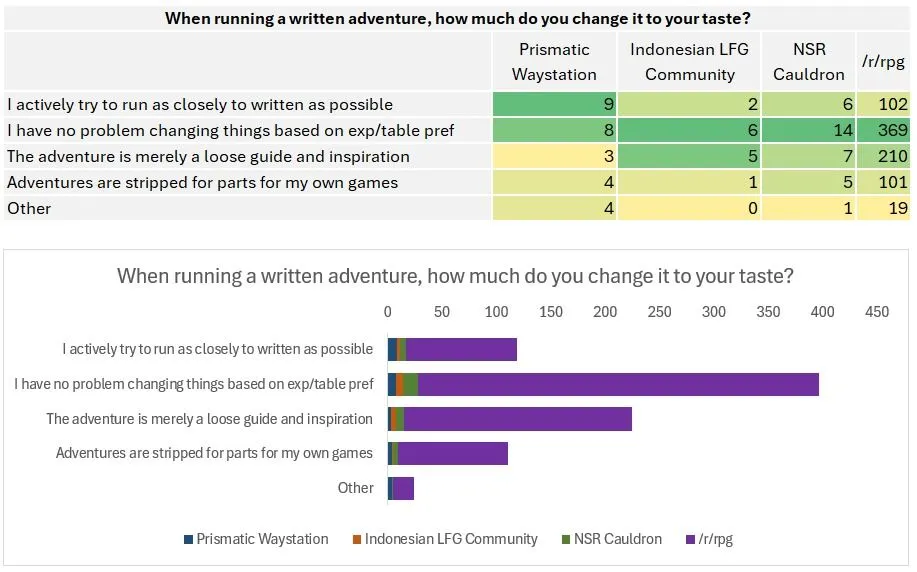
Not accounting for any bias from the polled locations - an unfortunate price to pay for raw information - the percentage of folks that actually take the adventure as gospel is frankly and surprisingly low, at 13.4%!
Most people - in between using adventures for parts like lego blocks from a set (12.5%), changing for preference (44.8%), all the way to my own vote in this poll, loose inspiration (26.5%) - actually use adventures rather flexibly.
But in odds to this, adventures as a whole are quite maximalist in their approach; they must abide for a full experience, present a completely playable package.
This could be read as an empty generalization, but consider for example the Appendix N Jam criteria of gameability:
Gameability: the module's ease of use. Does this seem easy to run? Are the concepts accessible? Would this require additional materials to work? How much prep time would this module require? Do the themes above come together in a helpful way?
For the intents and purposes of usability, though, more than 70% of the polled voters above would not judge gameability in the same light. Hell, 26.5% of them - myself included - could care less! They would all end in some new, undetermined place, beyond the margins and words of the text, far away from planned or unplanned expectations, and not only by the Player's decisions but my own.
But even so, there are "unplayable" adventures. Either by their own words, or popular opinion, they lack something, enough, to be "merely" a piece of art, or an experiment.
How can an adventure, by some objective criteria, fails in its Gameability enough to not achieve a Playability definition?
Orc Dungeon, by Idraluna Archives, an spectacular piece of game that you should download right now, is one such not playable adventure by its own description.
It has two maps, and all of the locations are fully keyed. But they don't explore the highend theorycraft of keys, surely: there are no landmark hidden secret, no loot, no random encounters, no codified rolls and challenges.
There is undoubtely an adventure, though. It exists in a fictional space, with a story to uncover and understand. One that, in play, will probably require the missing elements above to be constructed and construed from the vague descriptions of the industrial abandonment of the orc dungeon.
Is it any less of an adventure than other, more completed packages?
By objective, maximalist understandings, yes. It is less. It requires more prep. Additional material. Hell, it requires an entire system!
Unless you think those parts are elements of playing the game for you.
If you consider Play the act of discovering what does it mean for the orc dungeons to be an industrial hellscape, why is it abandoned, or coming up with the actual challenges of said not-dungeon, then Orc Dungeon is the complete.
Or even extrapolating: those full package adventures, if you are one of the sickos that want to figure out the game as it happens, and change it, and create new characters to respond to the Players' decisions - they are the inapropriate ones. They are the ones eliding all the fun and possibility out of the adventure!1
Alternatively, there is Vermis, a "official guide of a game that doesn't exist" that, also by its own words, "is not a game at all".
Allow me some leeway since Vermis does not describe itself as a Campaign Book or an Adventure necessarily. But the general consensus of it is its "non-playability". See this reddit thread, in which opinions vary from "good luck" to requiring "a fair bit of work".
Vermis has:
- 12 character backgrounds, each with full stats, lore and 2 items
- 5 detailed regions
- 5 maps, 3 of which are full dungeons
- of the 3 dungeons, two are partially keyed, one with 15 detailed rooms and encounters. The other is entirely keyed, room by room. All of them have bosses and mini bosses.
- 10 detailed NPCS
- 12 weapons
- 7 different items
- 3 random encounter tables of monsters, two with 12 entries and one with 15 entries
- a dozen other scenes detailed in between each of the five regions besides NPCs and monsters
What an incredible thing, that Vermis is considered not-playable at worst and a lot of work at best.
As Orc Dungeon could indeed be considered unplayable for lacking many of the present elements of an Adventure, Vermis, in its vagueness and subtle approach, falls into that same category - and they couldn't be more different.
It is far more than adventures I wrote to use myself!
Take the most recent Monastery of Saint George, a poem to be played. Or the starter adventure of Odd Kids, each location barely a phrase.
The latter was unapologetically written for my own use; these were real places from my own childhood, I don't need anymore keys to each than what I remember myself. The entire point of the game is to play your own memories! Incomplete by design, in order to hopefully motivate the reader to play their own nostalgia.
The former was written for the world; I wouldn't write a poem, in a foreign language, for my own table. But I did run it, and it worked perfectly to its intent. Incomplete by design, in order to let the story have room to breath different shades and flavors.
An eliding adventure.
To continue this experimentation, I have released today THROUGH BLACK ICHOR on Itch.io.
This is a full playable adventure in 177 words, for 3-5 sessions, based on Francisco de Goya's Las Pinturas Negras.
It's free, it's weird, but most of all, it is a playable adventure.
... but that would be an extrapolation, certainly. After all, only something written can be ignored.↩